

“Once sacred, rivers turned savage. Golden fields of mustard, Drowned beneath the weight of forgotten prayers”
(Dr. Gurpreet Kaur, from the poem “When the Rivers Wept”)
Our relationship with nature has always been one of dependence and reverence. The mountains guard our lands, forests shelter us and the rivers give life into them. But today this relationship is fraying. What once inspired and sustained us, now bears the weight of our neglect.
For centuries, rivers have been our lifelines, nurturing biodiversity, feeding farmlands, and sustaining spiritual and cultural traditions. Yet what once shaped civilizations and connected cultures are overflowing their banks, flooding homes, and crossing boundaries much like the humans have crossed theirs.
Their changing course is a reflection of the imbalance we have inflicted through pollution, commercialisation, and human exploitation along the floodplains. These floods, recurring with increasing intensity and frequency are warnings of disrupted ecosystems, broken management systems, and a widening gap between human ambition and ecological reality. It is time we look beyond emergency responses and begin to reflect on the possible causes and recommendations to strategically conserve the environment by protecting them.
Punjab, a state once celebrated for its wide-spread fertile lands and rich cultural heritage, has recently been facing a severe natural disaster in the form of wrath of God recently. The 2025 floods in Punjab was not just an environmental calamity, but a mirror of how deeply our actions have altered the course of river.
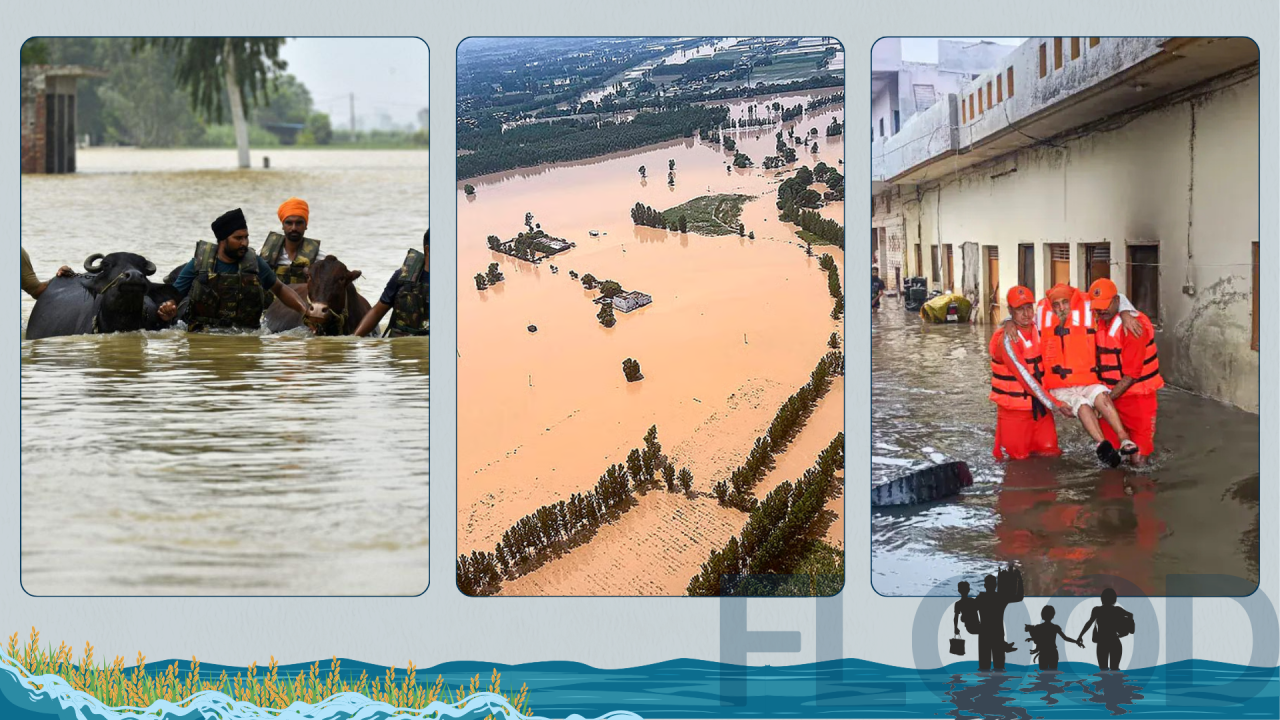
Continuous rainfall has led to a relentless rise in river and canal levels, surpassing danger marks and triggering widespread flooding, particularly across the Majha region[SJ1] [GK2] . Among the hardest hit was Rupnagar, located along the Sutlej, which bore the nature’s fury in an unforgettable manner. What unfolded wasn’t just a flood, it was a devastation. A reckoning with climate change that left behind broken infrastructures, and as with every disaster, shattered seasons, homes, crops, and livelihoods. Countless lives were disrupted, as residents found their homes and routines submerged beneath waters once seen at the seaside.
As soon as the floodwaters began to recede, I had the opportunity to walk through Shahpur Bela, a village in Rupnagar district, and the silence was almost heavier than the flood itself. The impact of the floods was evident everywhere. The air was thick and humid, carrying the smell of damp earth and spoilt grain. Old and young had down casted eyes, finding no words to express the floods that were still rising within. Children seemed confused and uncertain, while women worked to salvage what they could from damaged homes. The scene looked no less than a war zone. Within a few seconds, several nearby villages, including Bela Dhyani, Bhanu Pali, and Hariwal, had been inundated. Technology couldn’t be of any help, making recovery even more challenging when roads were washed away, electricity was snapped, and communication lines went dead.
The impact was visible across neighbouring villages as well. In Hariwal, I met a 70-year-old farmer Balbir Singh, sitting on a broken folding bed outside his flooded home. His voice trembled, not with age, but with disbelief.
“Jeda Paani denda si, us Paani ne sab kuch le liya. Ghar, samaan, kheti, jaanwar… kuch nahi bachya. Main 50 saalan to kheti kar reha haan. Aisi tabahi kaddi nahi dekhi.”
(Translated text – The water that used to give, took everything—home, things, crops, and livestock. I have been farming for 50 years. I’ve never seen such destruction.)
He had borrowed money to plant his maize crop, now reduced to a soggy ruin. The irrigation channels were blocked with silt, affecting the next sowing season. Many people had taken shelter in overcrowded relief camps, where families shared tarpaulin sheets, makeshift kitchens, and limited amenities. Volunteers whole-heartedly came forward to distribute food and medicines. But the deeper wounds are not those that tarpaulins or rations can heal. The floods had not only displaced people, they had dismantled their sense of stability and existence.
To understand and document the ground realities, I spoke with affected villagers. With key questions about the damage they faced: How did they manage during the flood? Did they receive any government assistance? What challenges did they face in resuming agriculture?
During the interviews, most of them spoke of widespread damage, be it their homes, grain stores, livestock, fields, or crops. Thick layers of silt and sand had rendered the soil temporarily infertile. Many families, especially those with elderly and children, had to take refuge in shelter houses. All essential services were disturbed. People were provided with mobile apps and government helplines to seek help and assist others. Government, civil society, and even many public figures came together to arrange funds and distribute essentials. Farmers received tractors to remove silt from fields, seeds for replanting, and other necessary agricultural support. However, these efforts highlighted the urgent need for long-term solutions such as regular canal maintenance, scientific desilting, and climate-resilient planning to prevent future disasters.
Punjab’s floods have become frighteningly familiar, in 2019, 2021, 2023, and now again in 2025. Each year, the pattern repeats, and each year, our response remains largely reactive. This pattern suggests a rising frequency of flood events, particularly affecting the Majha region (Source: Indian Express).
Yet, lessons remains unlearnt. Experts have repeatedly called for improved monitoring and early warning systems, stronger embankments, and better management of river and canal flows. At this moment, it is crucial to provide farmers with more seeds, agricultural aids, and timely compensation. Educating local communities about flood safety and emergency responses will be a great measure as well. Most important is to ensure proper canal cleaning and embankment reinforcement so that water flow can be managed effectively and future flood risks reduced.
Floods are no longer rare occurrences limited to Punjab, but have become a shared reality across the states. So, the floods of 2025 should not be remembered through numbers only: 52 lives lost, 2,000 villages affected, and nearly 1.91 lakh hectares of crops destroyed in Punjab alone. They must be remembered through the lived experiences and narratives of people like Balbir Singh, whose ruined fields must be taken as lessons of resilience and loss.
These stories are not just memories, but apprehensions, forebodings, and warnings of disasters that may return if we fail to act now. Let us take these lessons to heart and ensure that our rivers no longer weep. Their overfilled eyes should be taken as blueprints, for what must change with time.
Punjab has long borne both the blessings and burdens of water. Now, it is time that we respect them, with reverence as well as responsibility.

About the author- Dr Gurpreet Kaur works as an Assistant Prof. & Head, Post Graduate Department of English, Sri Guru Teg Bahadur Khalsa College and Head Post Graduate Department of English, Sri Anandpur Sahib, Punjab, India)
Sources:
2. Top-10 Flood-Prone Cities in India 2025: Cities, Causes and Challenges
3. 2008, 2019, 2023 and now: Why Punjab saw floods even when rainfall was normal