

There are places in the world that don’t just add to your understanding of nature, they change the way you see it. After years of extensive field work experience across the forests, farms, and forgotten landscapes of Maharashtra and Madhya Pradesh, I thought I had experienced most ecosystems firsthand. But one experience that has stayed with me was a winter afternoon in Sindhudurg district of southern Maharashtra, where I explored the endangered Myristica swamp ecosystem in Dodamarg taluka.
Entering the ancient swamp brought an immediate sense of change, the microclimate shifted, the air grew moister, and the temperature dropped as I stepped into this lush and waterlogged forest. The cool, humid atmosphere created by its dense canopy and water-soaked soils stood in stark contrast to the surrounding dry, deforested hills.
I spent about one and half hours exploring the Bambarde-Hewale Myristica swamp with my team, and a local guide who brought the forest alive with stories of its unique plants and animals. The swamp was buzzing with a variety of interesting insects, spiders, amphibians, and lizards. It was a reminder of how much life thrives in places we rarely talk about.
Myristica swamps were first documented in the southern Western Ghats of Kerala in 1960. Since then, more of these unique ecosystems are have been identified in Karnataka, Goa, and Maharashtra. Yet in Maharashtra, only two such swamps are known: one discovered in 2018 at Hewale–Bambarde, and another as recently as 2024 in Kumbral Bagwadi. The Bambarde–Hewale swamp, as our guide explained, marks the northernmost limit of this ecosystem in the Western Ghats.

These swamps are among the rarest freshwater ecosystems that occur mostly in moist evergreen forests of the Western Ghats. They are named after trees from the Myristicaceae family, a primitive group of flowering plants best known for species like nutmeg. Threatened species like Magnificent Nutmeg (Myristica magnifica) and Kanara Nutmeg (Gymnacranthera canarica) dominate these forests.
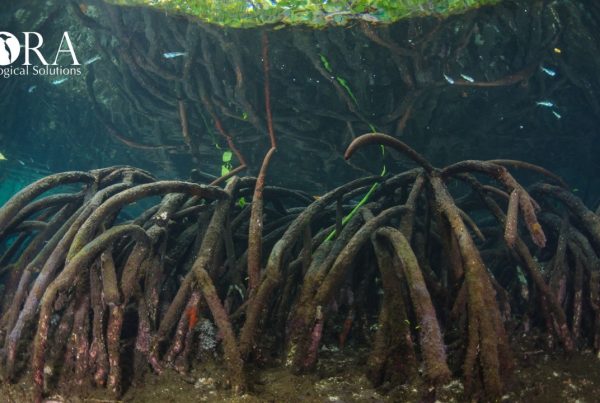
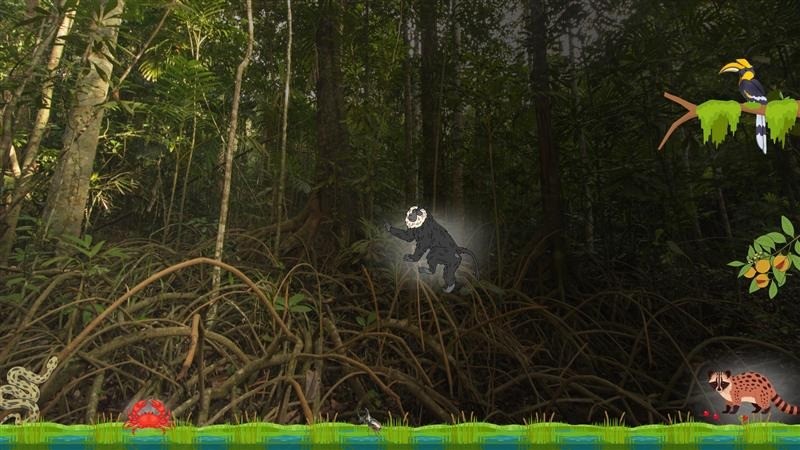
What sets these evergreen trees apart is their remarkable adaptation to waterlogged conditions. Their unusual aerial “knee roots” rise above the soil to facilitate gas exchange, while “stilt roots” support the trees in soft, swampy ground. These structures reminiscent of tropical mangrove swamps are vital for survival in this unique habitat. Carefully moving through the swamp, I often paused simply to admire and capture these structures, silent markers of nature’s resilience.
But just outside this ecological haven, the story shifts. The surrounding hills of the northern Western Ghats have been deforested and replaced with commercial plantations of rubber, areca nut, coconut, cashew nut, and rice. With the forest canopy gone, moisture levels in the area have dropped, groundwater levels have declined, and the evergreen landscape is rapidly drying. Even the swamp’s water is being diverted to adjacent paddy fields.

Later, scientific literature only deepened my concern. Numerous studies show that Myristica swamps support a total of 246 flowering species, with 30% being endemic to India. They are home to over 600 animal species and more than 206 butterfly species, of which more than 60% are endemic to the region. These swamps not only serve as crucial breeding grounds for many aquatic animals and amphibians but also help regulate temperature, filter pollution, maintain groundwater, and act as living records of ancient evolution.
Yet, these ecosystems are critically endangered, remain fragmented and restricted to small patches in Goa, Karnataka, and Kerala. They are continually threatened by commercial plantations, land-use change, and agricultural expansion. While some villages have protected these sites as sacred groves, many remain unprotected and highly vulnerable. Losing them would mean losing entire ecosystem and the invaluable microclimates they support.
This experience deeply reinforced my belief that awareness and community-driven conservation are urgent. Studies indicate that most suitable swamp areas lie outside the protected area network, precisely where they are most vulnerable to human exploitation.
Given their enormous climate value in storing carbon and sustaining hydrology, Myristica swamps are strong candidates for innovative conservation programs linked with biodiversity and carbon credits. Biodiversity credits are financial tools that channel funds from businesses and individuals toward conserving and managing ecosystems with high biodiversity value. These credits reflect measurable improvements in ecosystem health or species protection. When communities participate in earning and trading these credits, they not only receive economic benefits, but also become active partners in conservation, making preservation efforts more inclusive and sustainable. By providing financial incentives, such credits can empower local communities and landowners to protect and restore these fragile ecosystems. Updated policies could support their inclusion in protected area networks and incentive schemes.
World Wildlife Conservation Day, let us commit to a future where conservation is woven into development planning, where communities are empowered as guardians, and where financial systems recognize the immense value of intact ecosystems. Protecting these landscapes is ultimately about protecting our shared tomorrow.
Reference:
- https://www.researchgate.net/publication/356186756_Studies_on_Northernmost_Myristica_Swamp_Ecosystem_in_Western_Ghats_at_Bambarde-Hewale_Maharashtra_India
- https://india.mongabay.com/2019/11/why-the-ancient-myristica-swamps-need-more-protection/
- https://roundglasssustain.com/habitats/myristica-swamp
- Desai, P., V. Sadekar & S. Desai (2024). Discovery of a new Myristica swamp in the northern Western Ghats of India. Journal of Threatened Taxa 16(8): 25779 25786. https://doi.org/10.11609/jott.8952.16.8.25779-25786